- Life and perspective
- Building and learning
Before You Reach Higher, Know What Is Holding You
Watching my three-year-old son climb taught me something about risk: focus on the next step, but know which hand or foot will hold you if the new grip fails.
My three-year-old son was trying to climb higher at the playground.
I watched him search for the next place to put his foot. One hand was holding on. The other was reaching. His attention kept moving between where he was and where he wanted to go.
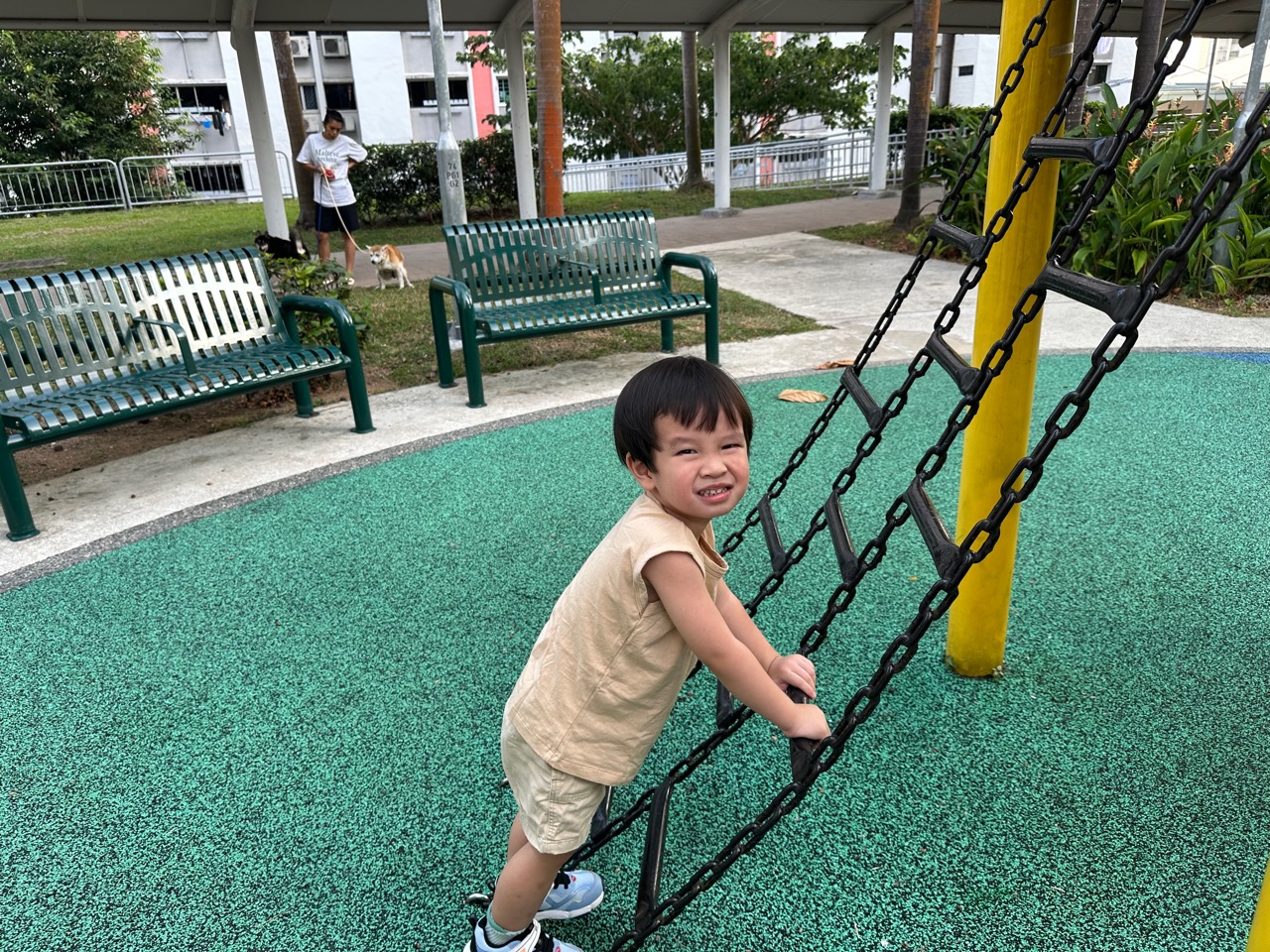
My son working out his next step on the playground climbing frame.
I told him:
Don't worry about the whole climb. Focus on the next step. Before you move one foot, make sure your other hand and foot are firm.
As I guided him, I felt a stirring in my heart.
Not so long ago, he could not even walk. He had to hold on to something just to stand.
Now he wants to climb higher and higher. The playground presents a new challenge, and his instinct is to find a way through it.
Watching him grow is one of the things that makes me proudest.
It also made me realise that what I was telling him about the playground was what I needed to remember about life.
Focus on the next step
When we look too far ahead, the whole climb can become frightening.
We imagine everything that could go wrong. We try to solve parts of the journey we have not reached. We compare our current position with someone who already appears to be at the top.
The result is often worry without movement.
My son did not need to understand the entire playground structure. He needed to know where his next foot would go.
Life often asks for the same focus.
The future matters, but we do not have to carry every possible future inside the present moment. We need to see enough direction to choose the next step, then give that step our full attention.
That may be the next conversation, the next decision, the next piece of work, or the next small attempt.
The next step does not complete the climb.
It creates a new position from which the following step becomes visible.
Focus does not mean reaching blindly
There was a second part to what I told my son.
Do not move everything at once.
Before one foot reaches higher, another foot or hand should be secure.
This does not remove risk. A grip can still slip. A step can still be misjudged. But it changes what happens when the next move does not work.
That is an important difference.
We often celebrate the reaching part of risk. We admire the person who left a job, committed everything to an idea, entered a new industry, or took a path that other people considered uncertain.
What receives less attention is the supporting leg.
Some people have savings. Some have a partner's income, family resources, a strong professional network, valuable skills, fewer dependants, or an easy route back into employment. Others may appear to make the same leap without any of those protections.
The visible action can look identical.
The consequence of falling is not.
Success stories rarely show the whole playground
This is what makes success stories dangerous when we copy them too literally.
The story usually focuses on the bold move because that is the dramatic part. Someone left stability behind. Someone took the risk nobody else would take. Someone believed when other people doubted.
The support beneath the move may receive one sentence, or none at all.
That does not make the success undeserved. A safety net cannot do the climbing for anyone. The person still had to work, decide, endure uncertainty, and reach for the next hold.
But the safety net changes the downside.
If one person can try for two years and return to a stable option, while another person's failed attempt threatens housing, family needs, or unmanageable debt, they are not taking the same risk simply because they made the same visible decision.
We should learn from successful people.
We should not assume that reproducing their action means reproducing their conditions.
What is your other foot standing on?
A supporting leg is not always money. It is whatever preserves enough stability, time, capability, or recovery room for the next move to remain survivable.
| The step you want to take | What may be supporting the other foot | What the support changes | The question to ask |
|---|---|---|---|
| Build a business while employed | Salary, evenings, existing skills | Progress may be slower, but essential expenses remain covered | Can I protect enough time to test the idea honestly? |
| Leave a job to build full-time | Savings, low fixed costs, a clear runway | More attention becomes available before financial pressure takes over | How long can I continue, and what signal will make me stop or adapt? |
| Enter an unfamiliar field | Transferable skills, mentors, professional relationships | Mistakes become easier to diagnose and recover from | Which capability will still be valuable if this direction fails? |
| Take a risk while others depend on me | Insurance, savings, shared agreement, fallback income | The downside is understood and not silently transferred to the family | Who carries the consequence if I am wrong? |
| Make a leap with very little protection | Determination, adaptability, willingness to rebuild | The upside remains possible, but recovery may be longer and harder | Am I prepared for the climb back, not only the climb up? |
There is no formula that makes a risk right or wrong.
The table is not an argument for always keeping a job, waiting until every condition is perfect, or choosing the safest available path.
It is an argument for seeing the whole position before moving.
Responsibility changes the calculation
Before becoming a father, a failed decision could be considered mainly through its effect on me.
Fatherhood widened the consequence.
As I wrote in how becoming a father changed my ambition, growth still matters to me. So do building, meaningful work, and financial progress. But stability is now part of ambition because more than one person lives with the outcome of my decisions.
That does not mean I should stop taking risks.
It means I cannot describe a risk as personal when the downside will be shared.
The supporting leg may be savings. It may be keeping a source of income while an idea is tested. It may be agreeing on a limit before committing more time or money. It may be maintaining skills and relationships that create a path back.
Thinking about these things is not a lack of courage.
It is part of taking the risk honestly.
There are always outliers
Some people begin with almost nothing and still make an extraordinary climb.
Their stories matter. They show what is possible.
But possibility is not the same as probability, and inspiration is not the same as a plan.
An outlier's result does not remove the consequences another person will face if the same attempt fails. It also does not reveal how many people made a similar leap and never became visible enough to tell the story.
This is where we need to be careful about being influenced by success stories.
Use them to expand what you believe may be possible.
Do not let them decide what level of risk is acceptable for your life.
That decision has to include your responsibilities, your resources, your ability to recover, and the price other people may pay with you.
Sometimes you may still choose to leap
There may be moments when the next hold feels worth reaching for even though the other foot is not as secure as you would like.
There is no universal answer that says you must not do it.
You may understand the downside and choose the leap anyway. You may believe the opportunity matters enough. You may decide that remaining where you are carries its own risk.
An informed decision is not necessarily a safe decision.
It is a decision made without hiding the cost from yourself.
If you choose to reach without much support, be prepared for the possibility that you will fall. Be ready to climb back. Do not interpret recovery as proof that the attempt should never have been made.
This is part of what I hope my children learn from watching me: starting before everything is known, learning from what happens, and beginning again without pretending that the previous attempt taught nothing.
The failure of one grip is not the end of the playground.
It may simply mean returning to a lower step and finding another route.
I can guide him, but the step is his
At the playground, I could tell my son where to focus.
I could remind him to keep one hand firm. I could help him see a foothold he had missed.
But he still had to place his foot and move his weight.
That may be one of the difficult parts of being a parent. We want our children to grow, but growth requires them to meet challenges we cannot complete on their behalf.
I do not want to teach him never to take risks.
I want him to understand the position he is taking the risk from.
Reach higher.
Focus on the next step instead of becoming overwhelmed by the whole climb.
But before you move, know which hand or foot is holding you. Know what happens if the next grip fails. Know whether you are willing to climb back and try again.
There is no perfect way up.
There is only the next informed step.