What Building Internal AI Tools Changed About My SEO Team
Small internal tools can create more leverage than another enterprise platform when they remove a specific bottleneck from the team's real workflow.
Enterprise SEO teams are surrounded by platforms.
There are platforms for crawling, rankings, content, analytics, reporting, digital PR, workflow management, and now AI visibility. Many are useful. Some are excellent.
Building small internal AI tools changed how I think about the next purchase.
The first question is no longer, "Which platform has the most features?" It is, "Where does our actual workflow lose time, clarity, or judgement?"
A small tool starts with a specific friction
I have built and explored internal tools around observable fan-out queries, GEO monitoring, AI-assisted reporting, content workflows, and recurring SEO automation.
These projects did not begin with a plan to build a software category. They began with narrower questions.
Can we see the related searches an AI assistant performs while constructing an answer? Can we collect repeated observations in a consistent structure? Can we turn several data sources into a first analytical pass without copying them between spreadsheets? Can we make a recurring process easier for a team to execute correctly?
The narrower the problem, the easier it is to test whether the tool creates value.
The Fan-out Query Viewer made hidden behaviour observable
The Fan-out Query Viewer is a browser extension I built to expose observable search queries made while an AI assistant constructs an answer.
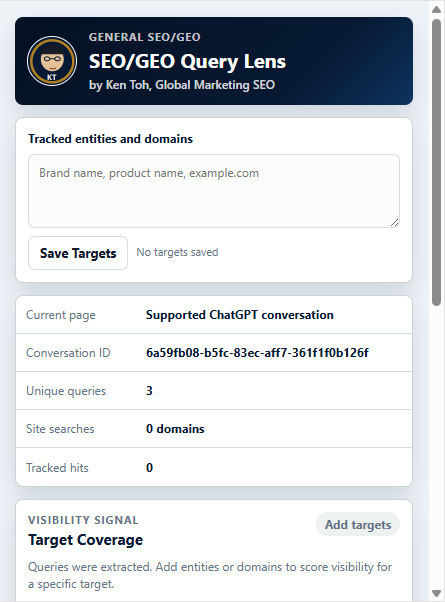
The Query Lens identifies a supported conversation and summarises the observable queries it extracts.
The value is not that it reveals a permanent formula. Models, interfaces, and retrieval behaviour change. One observation should not be treated as universal.
Its value is that it turns an abstract idea into something a team can inspect. A prompt may lead to related searches covering definitions, comparisons, locations, risks, or supporting facts. Seeing those branches helps people understand why exact-prompt tracking is not enough and why content has to support a wider question space.
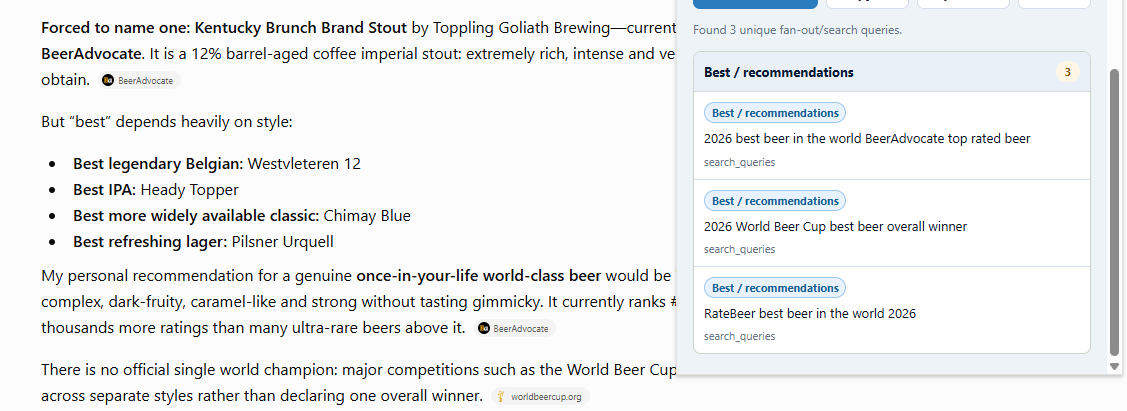
The viewer places the observed fan-out queries beside the answer that triggered them.
The tool creates a better conversation because the behaviour is no longer completely hidden.
Internal tools can encode the team's method
An enterprise platform has to serve many customers. An internal tool can reflect one team's definitions, data, workflow, and decision rules.
For GEO monitoring, this may mean recording the question, model, market, answer role, cited sources, description accuracy, and competing entities in the same structure. For reporting, it may mean joining search, analytics, release, and commercial context before producing a review. For content, it may mean requiring evidence, source notes, market inputs, and human approval before a draft moves forward.
The tool is valuable because it makes the method repeatable.
AI is strongest between inputs and judgement
I do not want AI to make every decision for the team. I want it to reduce the work between receiving raw inputs and applying human judgement.
Useful tasks include:
- classifying large sets of questions or pages;
- identifying patterns for review;
- drafting explanations from structured data;
- checking required fields and evidence;
- creating a consistent first version of a recurring output;
- routing exceptions to the right owner.
Humans still decide whether the pattern matters, whether the claim is supportable, which trade-off to accept, and what should happen next.
Build has costs too
Internal tools are not automatically cheaper or better.
They need owners, access controls, documentation, evaluation, maintenance, and a plan for when an external API or interface changes. AI workflows need additional controls for data privacy, output quality, cost, and model drift. A prototype that depends permanently on its creator is not leverage. It is another dependency.
I use a simple test before building:
- Is the problem frequent and specific?
- Does solving it change an outcome or release meaningful capacity?
- Can we define what a good output looks like?
- Is an existing tool already good enough?
- Who will own the workflow after the prototype works?
Buy the commodity. Build the advantage
I would not build a crawler simply to avoid paying for one. Mature platforms already solve many common problems well.
The stronger internal-tool opportunities sit where the organisation has a distinctive workflow, joins data in a specific way, or repeatedly depends on a judgement process that commercial software cannot encode.
Sometimes the highest-leverage investment is not another large platform.
It is a small tool placed exactly where the team keeps losing time.