GEO Measurement Starts With Agreeing What Success Means
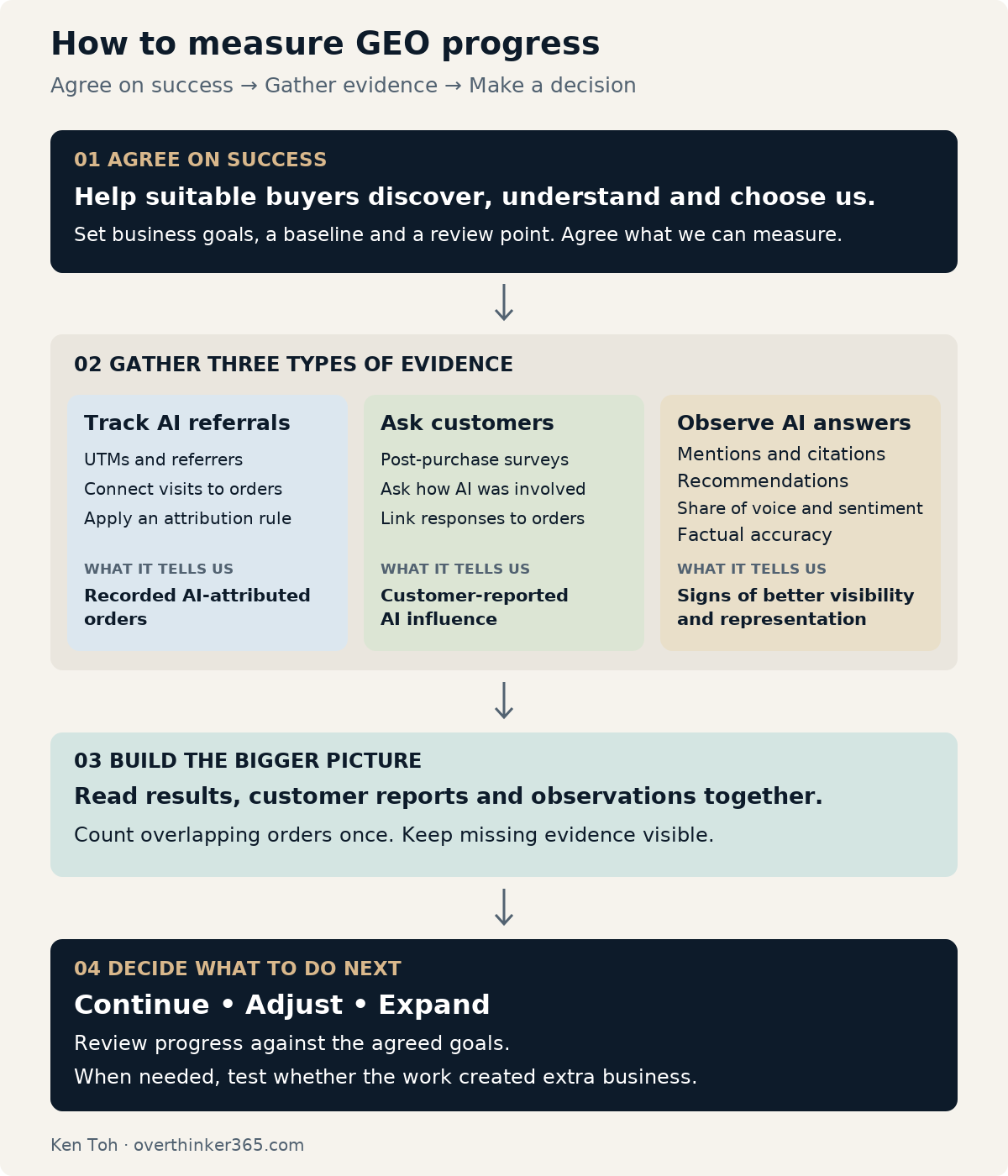
Before choosing a GEO dashboard, agree on what winning means. Separate recorded attribution, customer-reported influence and indicators that still need a commercial test.
How many orders did GEO contribute to?
It is a reasonable question when someone is funding the work. It also contains an expectation we should examine before accepting a target.
Some purchases can be linked to an identifiable AI referral and attributed under our reporting rules. Others may have been influenced by AI but appear in analytics as direct traffic or search. We need a way to report both, while being clear about how we know.
That distinction is where I think generative engine optimisation, or GEO, measurement should begin.
Before choosing the dashboard, we need to agree on what winning means, what we can measure, and how we will make decisions when part of the journey remains unknown.
Agree on the destination
“Improve AI visibility” is an incomplete business objective.
A brand can appear more frequently without becoming more relevant to its intended customers. It can be recommended for the wrong use case. It can be described positively using claims the business cannot support.
I would start with the customer decision we want to improve. Do we want suitable buyers to discover us? Understand our offering accurately? Include us in a shortlist? Resolve a concern that prevents them from proceeding?
Those outcomes should connect to a business purpose: qualified acquisition, customer quality, or reducing material misunderstanding. The organisation also needs to agree on the markets and products that matter, the investment available, and when it will review progress.
For example, a programme could aim to improve consideration among suitable buyers in two priority markets. It could then track identifiable acquisition, investigate how customers use AI to compare options, and test whether specific interventions improve outcomes. Targets should follow a baseline and a realistic assessment of the buying cycle.
That is a clearer agreement than promising a percentage increase in an AI score.
The comparison with brand investment is useful. Both can shape decisions before a measurable visit occurs. Both still require commercial discipline. Incomplete attribution should affect how we evaluate the investment; it should not remove evaluation altogether.
AI influence can sit behind direct traffic or branded search
The familiar SEO reporting path is straightforward: a customer finds us in search, visits our website and purchases. We can connect the recorded visit to the order and apply an attribution rule.
For example, if their first recorded visit came from organic search and they purchased 30 days later, a first-touch rule with a window covering that visit could count it as an organic-attributed order. The rule matters because first-user acquisition, session sources and conversion attribution answer different questions. Google's traffic-source documentation explains those distinctions.
Now consider two hypothetical AI journeys.
Path A: the customer clicks an identifiable AI link, visits and purchases. We can track that journey. If our agreed attribution rule gives AI the credit, we can report an AI-attributed order. This is a useful, measurable outcome.
Path B: the customer discovers or evaluates us through an AI answer, without clicking a link. Later, they type our website address or search for our brand and purchase. Analytics may record their arrival as Direct, Organic Search or Paid Search. The earlier AI interaction is absent from the recorded journey.
This is the gap we need to investigate: a purchase can be AI-influenced even when its recorded source is direct traffic or search. A branded search describes what the customer searched for; whether they clicked an organic result or an advertisement determines the recorded search channel.
That does not mean every direct visit or branded search came from AI. Those channels have many possible origins. We need additional evidence before identifying AI influence.
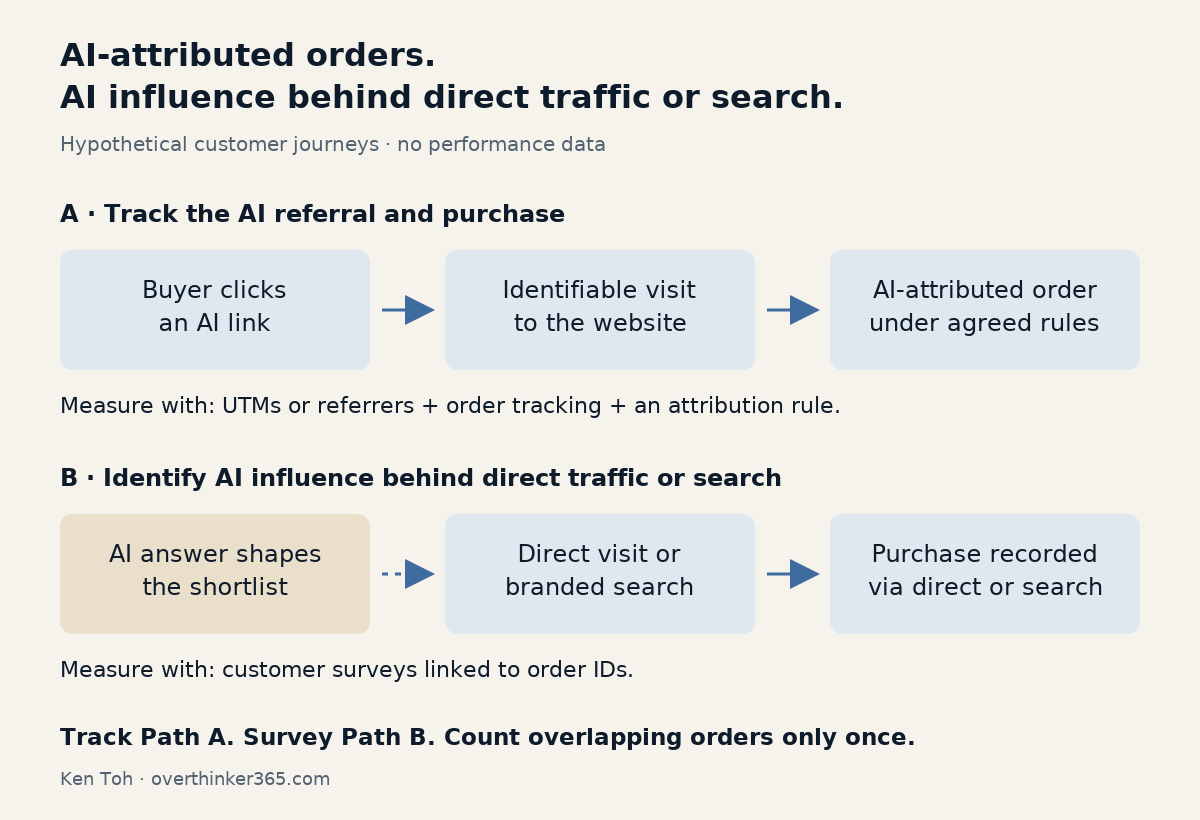
Figure 1. Path A can produce an AI-attributed order. Path B needs customer evidence to identify AI influence behind another recorded channel.
Use two reporting paths
I would start with two practical reporting paths, keeping the method visible beside each result.
| Reporting path | How we measure it | What we can say |
|---|---|---|
| AI-attributed orders | Identify AI referrals through UTMs or referrers, link visits to orders, and apply a stated attribution rule and time window. | Our reporting model credits these orders to AI referrals. |
| Additional orders with reported AI influence | Ask customers about AI's role, link responses to order IDs, and exclude orders already counted as AI-attributed. | These customers reported AI influence even though their orders were not attributed to AI. |
A survey can also confirm influence on an AI-attributed order. Keep that answer, but count the order only once in the combined view.
The first path uses recorded behaviour. The second uses customer accounts. Both are useful, but their evidence should remain distinguishable. Establishing whether our GEO work generated extra sales is a further question, which I will return to later.
Measure AI-referred visits with UTMs and referrers
For Path A, we need to identify the AI visit and connect it to a purchase. Two signals can identify where the visitor came from.
URL parameters
A visitor lands on a product page with utm_source=chatgpt.com in the URL. We can use that source value to classify the visit as ChatGPT-referred.
This is an example of a source tag we can recognise, not a guarantee that every AI link will carry one.
Referrers
Another visitor arrives without a UTM tag, but the recorded referring domain is perplexity.ai. We can classify that visit as Perplexity-referred.
Use either available signal to identify the visit. If both appear, it is still one visit. If neither identifies an AI source, leave the source unconfirmed. Google's documentation explains how campaign parameters and referrers populate traffic-source data.
A simple example from visits to orders
Suppose we are reporting for one month. These figures are illustrative:
- 60 visits are identified as coming from ChatGPT.
- 40 visits are identified as coming from Perplexity.
- Five of those visits include a purchase: three from ChatGPT and two from Perplexity.
For this example, our reporting rule gives the order to the source of the visit in which the purchase happened. We can therefore report:
100 recorded AI-referred visits and five AI-attributed orders: three from ChatGPT and two from Perplexity.
That is the practical job: group the identifiable AI visits, connect them to recorded orders, and apply a consistent attribution rule. In GA4, Session source / medium is a useful starting point for identifying the visits. The order record tells us whether a purchase followed.
What if the customer buys later?
Suppose a customer clicks an AI link on Monday and returns directly to buy on Friday. If we can recognise the same customer across both visits, we can connect the journey. We then apply our agreed rule for later purchases, such as giving credit to the first recorded visit within 30 days.
Under that example rule, Monday's AI visit gets the credit. A different attribution rule may assign credit differently, so state the rule beside the result. If we cannot connect the visits, we should not assume they belong to the same person.
Two ways AI involvement can be missed
1. The customer clicks an AI link, but we cannot identify its source.
Imagine someone taps our link inside an AI app and buys from our website. If the visit arrives without an AI referrer or an identifying URL parameter, analytics may record it as Direct. The click happened, but our report cannot identify it as an AI referral.
A missing referrer alone is not enough to lose the source: if a UTM parameter identifies the AI source, we can still count the visit as AI-referred. This depends on the particular link and app; not every AI-app visit loses its source information.
2. The customer uses AI, but never clicks our link.
Imagine someone asks an AI assistant to compare providers, puts us on their shortlist, then searches Google for our brand and buys. Analytics records the search visit. It cannot see the earlier AI conversation. The same gap exists if the customer types our website address directly into their browser.
In the first example, we are missing the source of a click. In the second, there was no AI click to track. A customer survey can help uncover either journey by asking how AI was involved, although the answer remains customer-reported evidence.
Direct traffic does not automatically mean AI traffic. It can include genuine direct visits and visits whose source could not be identified, as Google's explanation of Direct traffic describes. We need additional evidence before claiming AI involvement.
Measure customer-reported AI influence with a survey
To investigate AI influence behind direct traffic, branded search or another recorded source, I would start with an optional post-purchase survey. Offer it consistently across acquisition channels, including AI referrals, so we can see the overlap. In a lead-based business, the equivalent could be a consistent question after lead qualification. Choose one stage and keep the timing consistent.
Ask about the decision without assuming that AI helped:
| Question | Suggested answers | Purpose |
|---|---|---|
| Which sources, if any, did you use while deciding whether to choose us? | Search engines; AI assistants; reviews or publications; social media; people you know; other; none; do not remember. Allow multiple answers. | Identify research sources without assuming they were helpful or leading with AI. |
| If an AI assistant was selected: what role did it play? | Introduced us; helped compare options; answered a question or concern; increased confidence; raised doubts; no effect on the decision; do not remember. Allow multiple answers and optional detail. | Separate reported influence from usage alone, including negative influence. |
| Which AI assistant or experience did you use? | Named platform, other, or do not remember. | Understand where the reported influence occurred. |
Link the response to its order or lead ID. Count a reported influence only when the customer identifies a decision-related role, rather than simply saying they used AI. Keep positive, negative, no-effect and uncertain answers distinguishable. Follow-up interviews can ask what changed in the shortlist or understanding.
For a hypothetical month with 1,000 purchasing customers, suppose all are invited, 200 answer the survey and 40 report a decision-related AI influence. The defensible report is:
40 of 200 respondents reported AI influence: 20% of respondents. The survey response rate was 20% of the 1,000 purchasing customers invited.
It is not evidence that 20% of all customers were AI-influenced. Non-respondents may differ, and customers may misremember their journeys. Keep the question wording and timing consistent, and show the response rate beside the result.
Purchasers also tell only part of the story. Prospect research and lost-customer interviews can reveal cases where AI discouraged a purchase. Report those findings separately from the post-purchase survey.
Combine the evidence without counting orders twice
An order can be AI-attributed and also have a survey response reporting AI influence. Those are two pieces of evidence about one order.
For another hypothetical example, assume the same reporting period and one order per customer: 12 orders are AI-attributed under our agreed whole-order rule, 40 customers report AI influence, and eight orders appear in both groups. That gives us 12 AI-attributed orders + 32 additional orders with reported AI influence = 44 unique orders with evidence of AI involvement.
Report the 12 and 32 separately alongside the combined count. There may be other AI-influenced customers who did not answer the survey or could not recall the interaction, so 44 is the count we have evidence for, rather than a complete total. If the attribution system assigns fractional credit, report that separately from unique-order counts.
The same principle applies to a wider organic programme: organic-attributed orders plus additional orders with evidence of organic involvement, after deduplication. Keep conventional search and unpaid AI referrals as distinct subchannels.
Use observations to strengthen the evidence of progress
Alongside attributed orders and customer surveys, we can also track brand mentions, brand citations, share of voice and sentiment. These observations show whether our brand is becoming more visible, more useful as a reference, and better represented in AI answers.
Think of these measures as pieces of a jigsaw puzzle. Brand mentions tell us whether we appear. Citations show whether our content is used as a reference. Accuracy tells us whether customers receive the right information. Surveys add what customers remember, and recorded orders connect some visits to purchases. Together, they help us judge whether we are doing well, even though parts of the picture remain missing.
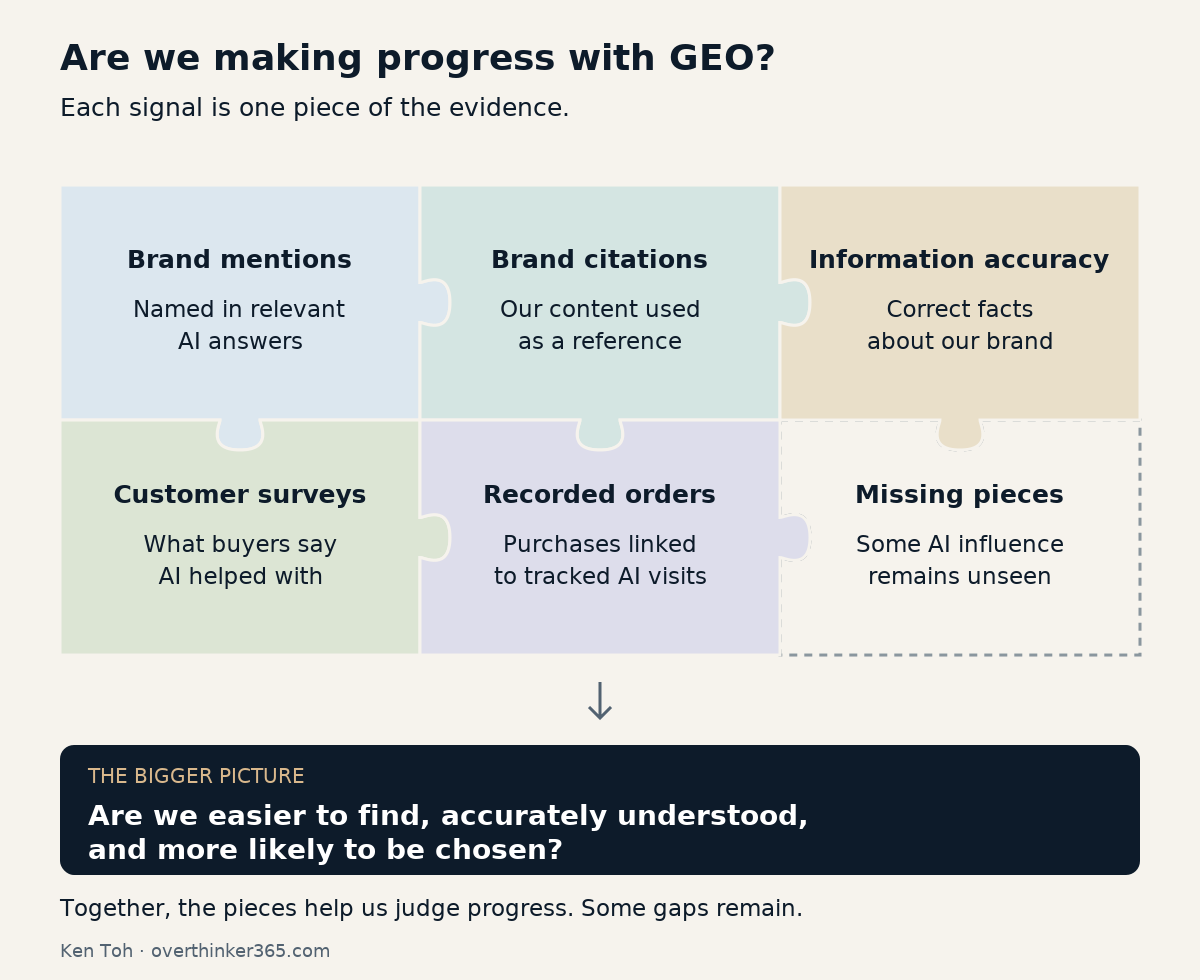
Figure 2. Each measure contributes part of the picture. Read them together to judge progress; no single piece captures the whole customer journey.
What does a win look like?
Imagine we sell inventory software to small retailers. The examples below are hypothetical.
| What we observe | What it means | Example of a win |
|---|---|---|
| Brand mentions / visibility | How often our brand is named in the AI answers we monitor. | Someone asks, “What inventory software should a small retailer consider?” Our brand appears among the relevant options. Across repeated checks, we appear more often. |
| Brand citations / cited sources | Whether an AI answer links to our website or content as a reference. | Someone asks, “How can I reduce stockouts?” The answer explains the process and cites our stock-planning guide as a source. Our content is helping answer a relevant question, even if nobody clicks. |
| Share of voice | Our share of tracked brand mentions compared with competitors. | Across the same set of retail-software questions, a larger share of the brand mentions belongs to us. We are gaining visibility relative to the brands we track. |
| Brand recommendations | Whether the answer explicitly suggests our product for a suitable need. | Someone asks, “Which inventory software suits a retailer with two shops?” AI recommends our product and explains how its multi-store features fit that need. |
| Brand sentiment | How positively, neutrally or negatively AI describes our brand. | Answers comparing providers increasingly recognise our ease of setup, supported by credible evidence, while still explaining genuine limitations. |
| Information accuracy | Whether the facts AI gives about our product are correct. | AI previously said we could support only one shop. Later checks correctly describe our multi-store support, removing a false reason to exclude us. |
Being mentioned, being cited and being recommended are different wins. A mention names our brand. A citation uses our content as a reference. A recommendation suggests choosing our product. A citation to a guide does not automatically mean the answer recommends buying from us. Also track third-party citations, such as a review that discusses our brand, separately from citations to our own website.
Look for a pattern of progress
Suppose our guides are cited more often, our product receives more relevant recommendations, and a greater share of survey respondents say AI helped them compare us. If recorded AI-referred orders also rise, these findings together strengthen the case that performance is improving. They do not tell us exactly how many extra sales our work created.
The pieces can also disagree. More citations alongside flat orders and little customer-reported influence give us a reason to investigate further. We should look at how the evidence fits together before deciding whether to continue, adjust or expand the work.
Compare the same topics, prompts, platforms, markets and languages over time, using repeated checks. A win on a question relevant to our buyers matters more than a mention on an unrelated topic. Label results as findings from the monitored sample; they do not represent every customer conversation. Read the actual answers too: a higher sentiment score does not help if it comes from inaccurate claims.
I have covered the operational side in my practical framework for AI search visibility. The purpose here is to connect what we observe with customer feedback and business results, so we can decide what to improve next.
A further question is whether our work created extra sales
AI-attributed orders and reported AI influence are useful results in their own right. A leadership team may also ask how much extra business a particular GEO investment created.
This is sometimes called incremental impact: the business we gained above what would have happened without that work. In a hypothetical example, if we would have received 100 orders without the intervention and received 110 with it, the extra 10 are the gain. We need a credible way to estimate the 100, rather than assume every AI-attributed order is extra.
This question does not prevent us from reporting AI-attributed orders. It helps us decide whether to expand a specific investment. AI may already have been sending customers before we made a change.
Consider a hypothetical software provider whose answers repeatedly omit an integration that its product supports. The team clarifies the documentation and corrects outdated information in relevant sources.
Later samples describe the integration accurately. That is a useful, observable improvement. The commercial hypothesis is that suitable buyers will now be less likely to exclude the product for the wrong reason.
To investigate that hypothesis, the team could examine buyer understanding, qualified enquiries and subsequent outcomes. Where the circumstances allow, a staggered rollout across comparable groups can provide a stronger comparison than a simple before-and-after chart. The aim is to estimate the extra enquiries or orders caused by the change, using the comparison group to understand what might have happened without it.
That comparison still needs enough observations, a suitable evaluation period and attention to other changes. Markets may differ, information can spread between groups, and product or paid-media changes can affect results. An inconclusive result should remain inconclusive.
If the documentation improves both conventional search and AI discovery, report the intervention's combined effect unless the design can isolate the AI component.
Also, a correction can reduce unsuitable enquiries. Fewer leads may accompany better customer quality. This is another reason to agree on success before celebrating a higher number.
Make the review lead to a decision
A workable review rhythm might use monthly checks to catch factual errors and operational issues, with investment reviews timed to the buying cycle and the evidence available.
The review should consider three questions together: what changed in the business, what changed in the indicators, and how confident we are in the connection.
An improved indicator with no supporting customer evidence may justify another bounded test. Repeated factual errors may require product, brand or documentation owners to act. Credible commercial improvement may justify expansion. Repeatedly inconclusive work should trigger a decision about its cost and priority.
Measurement quality belongs in that review too. A higher survey response rate can increase the number of reported AI-influenced purchases without generating another sale. A changed monitoring sample can alter a visibility percentage without improving the underlying position.
This is consistent with my argument that SEO reporting should lead to a business decision. GEO adds uncertainty, but it does not change the purpose of reporting.
The leadership commitment I would make is straightforward: we will define the outcome, show what we can observe, investigate what we can reasonably estimate, and change the investment as the evidence develops.
We will rarely have every piece of the puzzle. The task is to use the evidence we have to make a better decision about what to do next.