- Life and perspective
Knowing a Moment Is Not the Same as Living It
A photograph can show us where we were. A memory can tell us what happened. Neither can return us to the exact moment when life was still unfolding around us.
A travel photograph can show me a beautiful place.
I can see the mountain, the street, the building, the sea, or the people who were there. I can zoom in on the details. I can remember where the photograph was taken and what happened before or after it.
But looking at the photograph is not the same as being there.
The image cannot fully return the temperature of the air, the sounds around me, the tiredness in my body, the thoughts in my mind, or the feeling of not yet knowing what would happen next.
The photograph preserved a view.
It did not preserve the whole experience.
That difference between knowing and experiencing may be one of the most important differences in life.
Knowing is a description. Experiencing is participation.
We can know many things without experiencing them.
We can read about a country without visiting it. We can understand how a difficult decision works without carrying its consequences. We can listen to someone describe parenthood, loss, success, responsibility, or love without becoming the person who lived through it.
The knowledge may be accurate. It may even be detailed.
But experience adds things that information cannot fully carry.
It adds our body, our attention, our circumstances, our emotions, the people around us, and the fact that the outcome is still unknown while the moment is happening.
Knowing allows us to stand outside something and examine it.
Experiencing means we are inside it.
We are no longer only understanding what happened. We are part of what is happening.
A memory is not the original moment
The same difference appears when we think about the past.
A memory can feel vivid. We may remember a place, a face, a sentence, or the way a particular day changed us. Sometimes a photograph brings back details we thought we had forgotten.
Yet remembering that moment today is not the same as living it then.
Today, we know what came next.
At the original moment, we did not.
We did not know that an ordinary conversation would later become precious. We did not know that a familiar place would change. We did not know how quickly someone would grow, how a relationship would develop, or which small moment would stay with us for years.
Memory looks backwards with an outcome already attached.
Experience moves forwards without that certainty.
That is why we can return to a memory, but we cannot truly enter it again. The person remembering has already been changed by everything that happened afterwards.
What remains is not the whole thing
Different forms of remembering and understanding preserve different parts of life. Each is valuable, but none should be confused with the living moment itself.
| What remains | What it can preserve | What it cannot return | What it asks of us now |
|---|---|---|---|
| A photograph | A place, face, arrangement, or visible detail | The full surroundings, inner state, and flow of time | Look beyond capturing the scene and notice being inside it |
| A video | Movement, sound, and a short sequence | Everything outside the frame and the experience of the person recording it | Record selectively so the device does not become the main participant |
| A memory | Meaning, emotion, and the parts that stayed with us | The exact mind we had before we knew what followed | Value what the memory reveals without pretending we can return |
| Another person's story | A perspective, lesson, or account of what happened | The consequences, sensations, and uncertainty they carried | Listen seriously, while remembering that understanding is not the same as living it |
| Knowledge | An explanation, pattern, or principle | The reality that tests and completes the idea | Let experience refine what we think we know |
The point is not that photographs, stories, memories, or knowledge are inadequate.
They are some of the ways we keep meaning after time has moved on.
The point is that evidence of a life is not the same as the life being lived.
We often become grateful too late
There is something strange about the way we value moments.
While a moment is happening, it may feel ordinary. We are distracted. We are thinking about the next task. We are trying to get somewhere, finish something, or solve a problem that appears more urgent.
Later, when the moment exists only as a memory, we suddenly understand its value.
We look at the photograph and wish we had paid more attention.
We remember the conversation and realise that we were already inside something meaningful.
We miss a period of life that we did not recognise as special while we still had it.
Perhaps this is unavoidable to some extent. We cannot know in advance which moments will become important. If we tried to treat every second as profound, we would probably become exhausted by the effort.
But we can become more aware of a simpler truth:
Much of what we will one day miss does not look extraordinary today.
Children grow while the days still feel ordinary
This feels especially real when I look at my children.
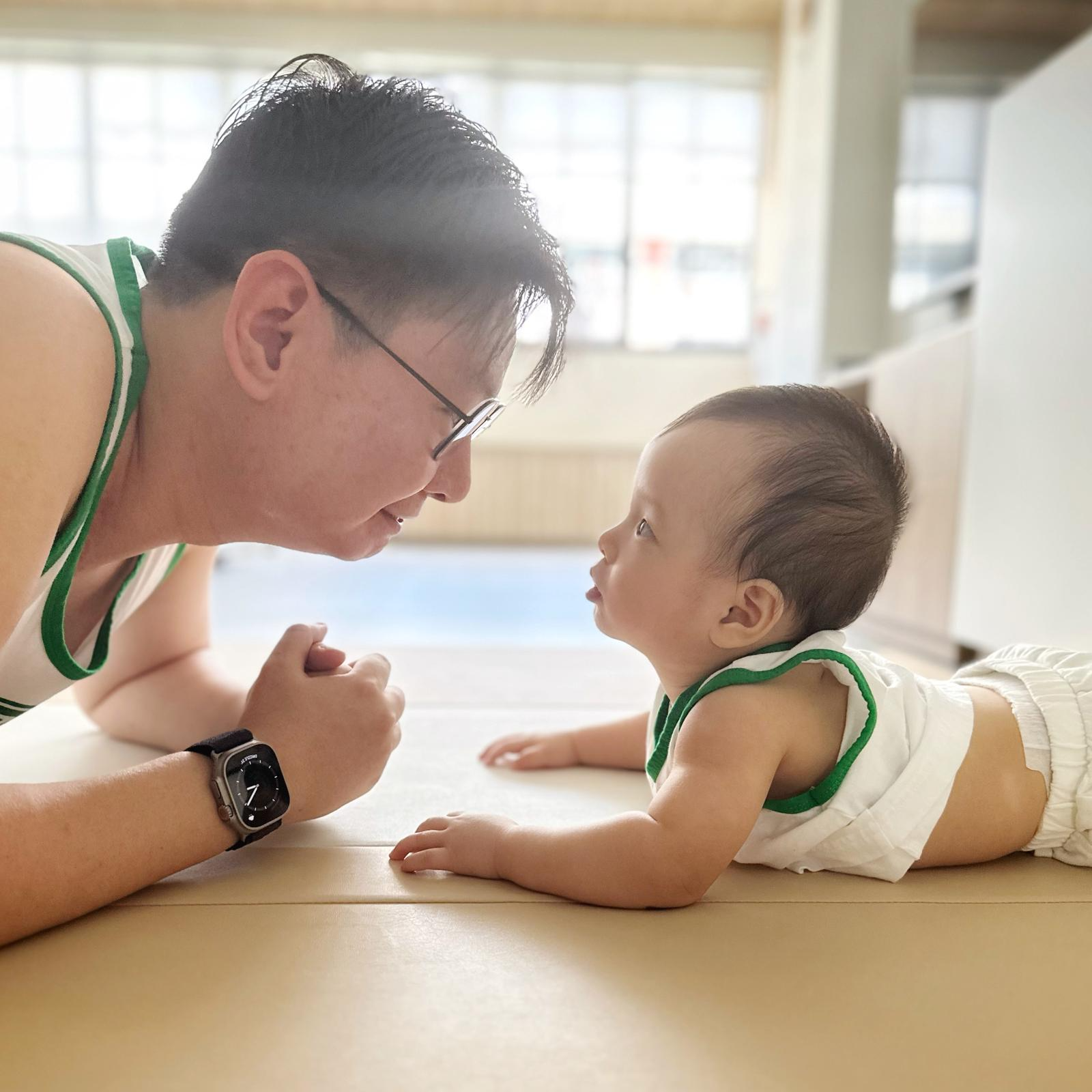
Being present with my child while this stage was still ours.
We all know that children grow quickly. Knowing that sentence is easy. Experiencing their growth while it is happening is different.
From one day to the next, the change can seem almost invisible. The routines and responsibilities continue, and the current stage can feel as though it will be here for a long time. Then we look at an older photograph and realise that the child in that image no longer exists in exactly the same way.
In a reflection on guiding my son through a playground climb, I wrote about remembering when he needed support just to stand and then watching him try to climb higher. The photograph can preserve how small he was at the playground. It cannot return me to the experience of standing there while he was still becoming the person he would be next.
Watching our children grow is not only something we observe.
It is an experience we are inside with them.
One day, I may deeply miss the version of them that is in front of me now. I do not want to realise the value of this stage mainly through photographs after it has passed. I want to feel it while it is still happening, including the ordinary days that do not yet look like memories.
Being present cannot stop children from growing. It lets us grow with them instead of noticing the distance only afterwards.
Presence is not another performance
Being present does not mean forcing ourselves to enjoy every moment.
Some experiences are tiring, painful, boring, confusing, or difficult. Gratitude should not become a rule that asks us to deny what is hard.
Presence is more honest than that.
It means noticing what is here before automatically leaving it for the next thought, the next notification, the next obligation, or the next version of life we hope to reach.
It means allowing a conversation to be the thing we are doing, rather than background noise while our mind is elsewhere.
It means occasionally putting down the camera after taking the photograph and looking directly at the place we came to see.
It means recognising that an ordinary meal, a familiar voice, a quiet journey, or time beside someone we love is already an experience. It does not need to become a memory before it deserves our attention.
In we already know what to do, I wrote that knowing our loved ones matter is not enough. That knowledge has to become visible in where our attention goes.
Presence is where that knowledge enters the moment.
Experience completes a different kind of knowing
I have also written about 知行合一, the unity of knowing and doing. An idea remains incomplete when it never meets action and reality.
Knowing and experiencing have a similar relationship, but they are not identical.
Action tests whether we can apply what we know.
Experience changes the person doing the knowing.
Before an experience, we may understand the words. Afterwards, the same words can carry a different weight because they now have consequence, sensation, effort, and memory attached to them.
Someone can tell us to be grateful for time with the people we love.
We can agree immediately.
But agreement is still outside the moment. The deeper understanding appears when we stop, pay attention, and actually live the time we have with them.
The lesson does not become more sophisticated.
It becomes real.
Life is happening before we understand it
We spend a great deal of time trying to understand life.
We analyse what happened. We explain our choices. We keep photographs. We tell stories. We turn experience into lessons so that something useful remains.
All of that matters.
But life does not wait until we have understood it.
It is happening while we are uncertain, distracted, busy, tired, or thinking about something else. The present does not announce which parts will later become important. It simply becomes the past.
One day, the scene in front of us may be a photograph.
The person beside us may be someone we remember from a different stage of life.
The ordinary routine we barely notice may become something we would give a great deal to experience once more.
We cannot stay inside every moment forever.
We can only be there while it is ours.
Be grateful before the moment becomes a memory
Perhaps gratitude is not only looking back and appreciating what happened.
Perhaps it is recognising, while life is still happening, that this moment cannot be completely stored for later.
Take the photograph.
Keep the memory.
Learn from the story.
But do not mistake any of them for being there.
Look up. Pay attention. Listen properly. Notice who is beside you and what is happening before the future gives the moment a meaning you cannot yet see.
Knowing life is not the same as living it.
The essence of life is not only understanding what happened.
It is being there while it happens.